
The Science
This machine does not operate on a single frequency. It operates on all of them at once.
The ZVS, spark gap, and LC tank circuit together generate fundamental driving frequencies in the 21 to 71 kHz range. Within each discharge event, the LC tank rings at these frequencies, while the spark gap itself breaks at a much lower repetition rate, producing the sharp, abrupt, non-sinusoidal impulse that Tesla identified as the key to generating the radiant/scalar component on top of the conventional broadband RF output. A smooth sine wave at the same frequency cannot produce this effect, because it lacks the steep wavefront responsible for the longitudinal impulse. This is the fundamental reason why a conventional frequency generator cannot replicate what this machine does.
The spark gap simultaneously generates thousands of harmonics from those fundamentals, stepping up through the frequency spectrum, crossing 10 MHz around the 140th harmonic and extending into the gigahertz range. The plasma inside the bulbs independently generates additional frequency components through non-linear self-organization. The result is a continuous, broadband emission spectrum from the low kilohertz to the gigahertz range. Our research focuses particularly on the kHz to low MHz band, a range the scientific community is currently evaluating for its specialized interactions with biological systems.
Tesla believed the longitudinal/scalar wave component doesn't propagate at the speed of light like conventional EM, it propagates through the ground and aether instantaneously, meaning it technically doesn't have a classical frequency in the Hertzian sense.
Frequency Machines
Most devices marketed as frequency machines, such as Rife machines, PEMF devices, function generators, etc., produce conventional electromagnetic (EM) waves. These are transverse waves: the energy oscillates perpendicularly to the direction the wave travels, like ripples on water. They work within a specific, narrow frequency range, and their energy dissipates over distance, the farther you are, the weaker the signal.
What Makes Scalar/Longitudinal Waves Different
Scalar energy, as Tesla identified it, operates as a longitudinal wave, the energy oscillates in the same direction as the wave travels, similar to how sound moves through air as compressions and decompressions. The key differences are:
No energy loss over distance: unlike transverse EM waves, scalar/longitudinal waves are theorized to transmit energy with minimal dissipation
No transverse magnetic component: scalar/longitudinal waves do not carry a magnetic field, meaning they interact with matter differently than standard EM radiation.
Not described by standard Maxwell equations: they operate outside conventional electromagnetic theory, which is why mainstream science largely overlooked them after Tesla
They penetrate matter: conventional EM waves are attenuated or absorbed by solid objects depending on frequency and material density; scalar/longitudinal waves are theorized to pass through matter without meaningful attenuation.
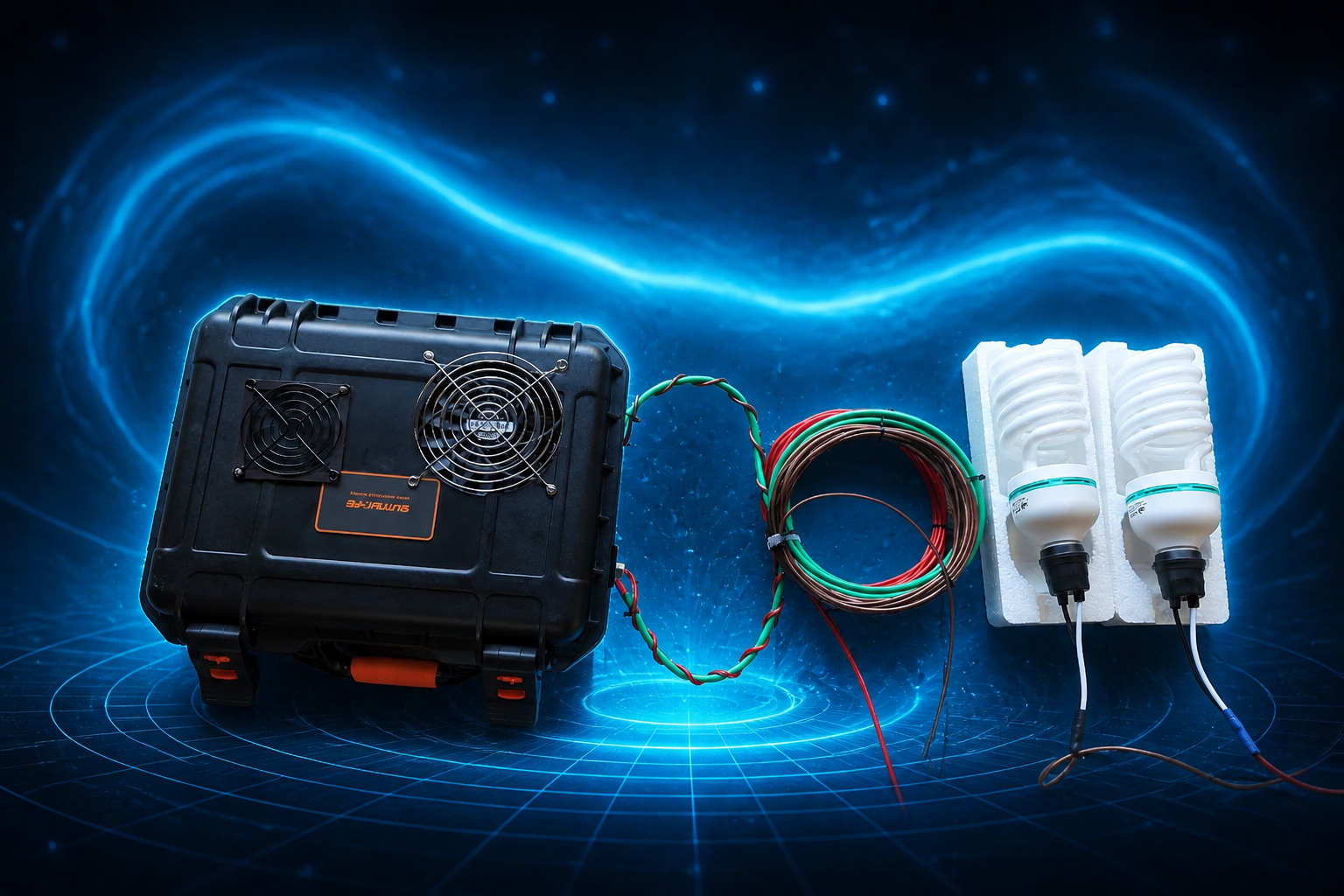
How to understand this technology?
Understanding the work of Lakhovsky, D'Arsonval, Oudin, and Tesla is essential for comprehending the scalar machine.
Georges Lakhovsky
1869-1942Lakhovsky's Multiple Wave Oscillator (MWO) theory is foundational. He theorized that cells act as electromagnetic resonators and that biological equilibrium is linked to harmonic oscillation. His device used concentric ring antennas designed with golden ratio patterns to produce a wide spectrum of frequencies (1 Hz to 300 GHz) with harmonics and sub-harmonics, generating a "MultiWave Oscillating Field". Each ring radiated at different wavelengths based on its diameter, creating interference patterns that generated countless harmonic frequencies.
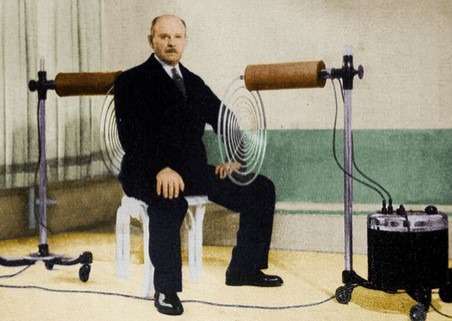
Jacques-Arsène D'Arsonval
1851-1940D'Arsonval pioneered high-frequency current research using currents of 100-500 kHz at low intensity and high voltage (up to 30 kV). His work demonstrated that high-frequency currents do not trigger nerve responses. This principle underlies why your machine can use high voltage in an experimental setting safely.
Paul Marie Oudin
1851-1923Oudin modified D'Arsonval's equipment in 1893 by creating the Oudin coil, a resonant transformer using spark gaps and Leyden jar capacitors to generate high voltage at resonant frequencies. The circuit used a spark gap as a switch to excite oscillations in a resonant LC circuit, exactly like this machine's design.
Nikola Tesla
1856-1943Tesla's resonant transformer principles (Tesla coil) are the technological foundation, using LC resonant circuits, spark gaps, and electromagnetic induction to generate high-voltage, high-frequency energy. This machine essentially follows this same architecture.
Understanding these pioneers explains why this machine uses spark gap, resonant capacitor banks, high-frequency oscillation, and broad-spectrum harmonic generation.
This machine combines all these principles: Tesla's spark gap resonant transformer technology, D'Arsonval's therapeutic high-frequency application, Oudin's resonator coil design, and Lakhovsky's multi-frequency cellular resonance theory. Without understanding their contributions, you'd only see electronic components rather than a coherent energy system based on electromagnetic resonance.
To understand how the scalar machine works, you need foundational knowledge in these areas:
Basic Electronics
Understanding voltage, current, power, capacitance, and inductance is essential. You should know how power supplies convert AC to DC, what capacitors do (store and release electrical energy), and how inductors (like the flyback transformer's windings) create magnetic fields.
High-Voltage Circuits
The ZVS (Zero Voltage Switching) driver and flyback transformer create high voltage from the 12V supply. Understanding how transformers step up voltage through electromagnetic induction and how spark gaps function as voltage-controlled switches is crucial.
Resonant Circuits and Tesla Coil Principles
Your machine operates on resonance, the spark gap and capacitor banks create oscillating high-frequency energy. This is similar to Tesla coil technology, where energy pulses back and forth between capacitors and inductors at specific frequencies.
Scalar Energy
This device generates longitudinal waves (scalar waves) rather than conventional electromagnetic waves. These are theorized to penetrate matter and interact with local environmental fields.
Energy Field Concepts
Understanding the interaction between high-frequency pulsed energy and the bio-electric environment helps explain how this device operates.
The machine converts low‑voltage DC into pulsed high‑voltage, high‑frequency energy through resonant circuits, creating conditions for scalar wave generation. It is designed to deliver this energy in a controlled, tunable way so that the intensity and frequency can be adapted to different experimental contexts.
This explanation is a useful starting point, but it's simplified. The reality is more complex, and someone would need to study much more deeply to truly understand how the machine works.